We have been talking about mental health and wellbeing in our group, and wanted to share some of our thoughts and learning, so if you are having any of these thoughts, please make sure you talk to a trusted adult or you can phone Childline on 0800 1111.
We invited Meghan Mysa who is new to Adoption UK and has been employed to start a new therapeutic service just for adopted young people aged 13-30. Meghan came to our group to talk to us about mental health. We discovered that adoption, like mental health, is an individual process and not one person’s experience is the same. We also discovered that adoption can play a part in our emotional wellbeing. We explored different things that can affect our mental health (including bullying) and we talked about the difference between being sad
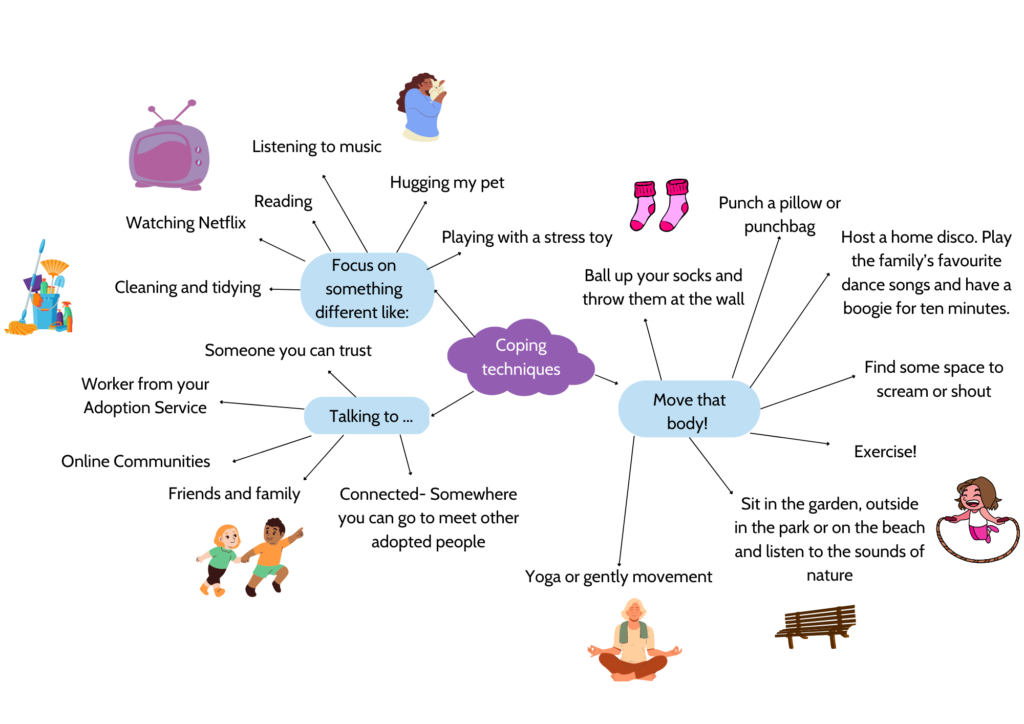
(for example a death of a loved one, a breakup) and being depressed. Also, we explored some coping mechanisms we know work for us and our friends.

Most adopted young children are more vulnerable to having mental health issues in comparison to the general public.
This could be as a result of a combination of factors:
Difficulties in relationships with family, friends or partners as a result of having had traumatic things happen to you in your birth family or in your time in foster care
Difficulties trusting people, especially parent figures, as a result of being let down by parent figures in the past or if you have been separated from parent figures in the past.
Difficulties feeling safe around adults with power, for example social workers, teachers, bosses at work etc, because for those who have had bad experiences with ‘professionals’ it can sometimes be hard to trust they have your best interests at heart.
Challenges associated with leaving home, such as moving to uni, moving in with friends, partner or just becoming more independent. A lot of adopted children have to work through a lot of complicated feelings such as a sense of imposter syndrome, and thoughts like “I feel like I shouldn’t be here, and I don’t deserve it.” “I don’t feel like I belong as I don’t see my features in my family”.
What is mental health?
The mental health charity Mind
explains mental health:
“Mental health is about how we think, feel and act. Just like physical health: everybody has it and we need to take care of it.
Our mental health is on a spectrum,
and can range from good to poor.
Good mental health can help you to
think positively, feel confident and act calmly. If you have poor mental health, you might find that the way you’re thinking, feeling or acting becomes difficult to cope with.
You might not enjoy things you used to like doing. You might feel sad or angry for a longer time than usual. Or you might feel like you can’t control how you feel or behave.”
Grounding techniques for when you
are feeling overwhelmed
Look at your feet/shoes and ask,
‘what size are my feet?’
Senses countdown:
5 things you see
4 things you can touch
3 things you can hear
2 things you can smell
1 thing you can taste
Belly Breaths – big deep breaths
Super Hug – Give yourself a big
hug and say “I am in control”
Complicated feelings like these can cause young people to be more susceptible to mental health problems. Attachment issues and adoption are interlinked, and during our session with Meghan we learnt about unconscious memories –where the body holds memories we don’t remember, maybe you may remember a scary situation when there were loud noises and when you hear loud noises now, this may trigger you and frighten you now but you don’t know why. This is very common among adopted children.
Preventing mental health issues within the adopted community – educating others about adoption
Schools need to be educated on the effect that talking about family structures as an activity can have on adopted children. Creating family trees in school can cause an adopted child to feel isolated and uncomfortable, it can also trigger some complicated feelings about identity.
Educating others could also prevent adopted children from having to face discrimination due to being adopted. Many of our members have discussed their experiences with being bullied due to people believing in negative stereotypes about adopted children. This could also help reduce the number of adopted children with mental health issues as a result of bullying.
Being more open with adopted young children about what adoption is and what that can mean for different people. Groups like Connected and Connect Voices are amazing ways to do this, as they do not only combat the loneliness that can come because of adoption by creating a community of similar people, but it can also help adopted young people understand and discuss what adoption is and what it means to them. It is important that adopted young people have an outlet to express their feelings and develop a deeper understanding on what adoption is to them.

One of our members after
joining Connected gained the
courage to go to college after
being home-schooled for 3
years!
Coping techniques
Here are some coping techniques that we have thought of. Some of these might
work for you too!